
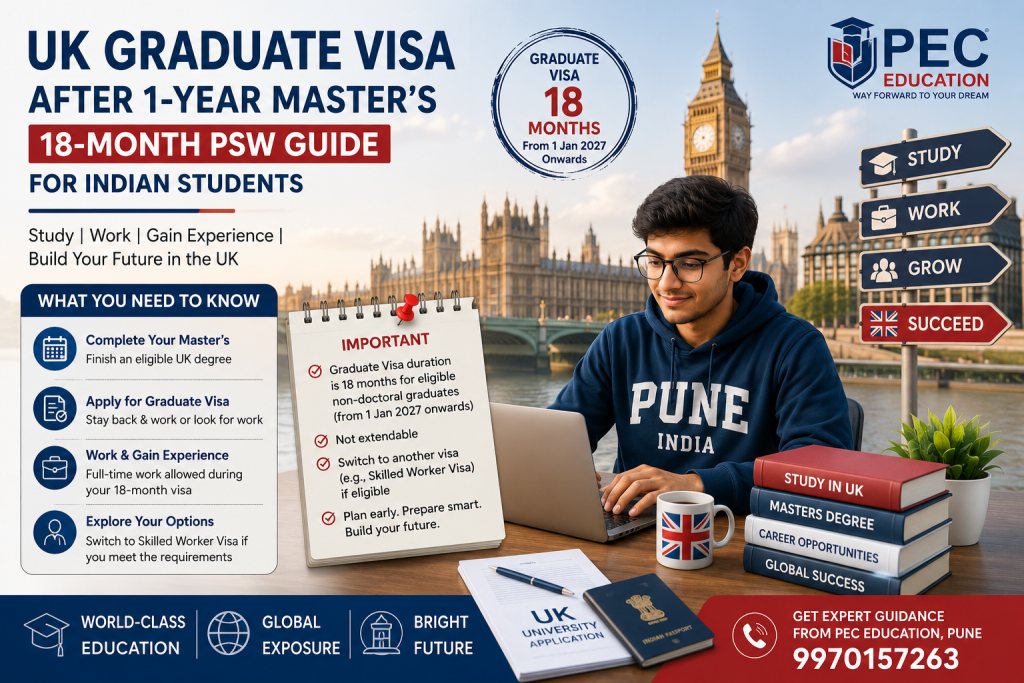
One of the most common questions Indian students ask before choosing a UK master’s degree is:
“After completing a one-year master’s degree in the UK, can I stay and work in the UK?”
The answer is yes, eligible international students may be able to stay in the UK after completing their course and work or look for work under the Graduate visa route.
However, the rules have changed.
For eligible applications made on or after 1 January 2027, the Graduate visa is currently scheduled to last 18 months for graduates who have completed an eligible non-doctoral qualification. Eligible PhD and other doctoral graduates can receive a three-year Graduate visa. Students who apply on or before 31 December 2026 may be eligible for the previous two-year period, subject to meeting the applicable requirements.
This change is especially important for Indian students planning to start a one-year master’s degree in the UK for the January 2027 or September 2027 intake.
The key point is:
After completing a one-year master’s degree, an eligible student may be able to apply for the Graduate visa. The Graduate visa is currently 18 months for applications made on or after 1 January 2027. After that period, the student may need to leave the UK unless they qualify for and switch to another visa route, such as the Skilled Worker route or another eligible immigration route.
This article explains the UK post-study work pathway in simple terms for students from Pune, Maharashtra and across India who are planning to study in the UK.
Quick Answer: Can I stay in the UK after completing a one-year master’s degree?
Yes, eligible graduates may be able to stay in the UK after completing an eligible UK course by applying for a Graduate visa.
For applications made on or after 1 January 2027, the current Graduate visa duration is:
| Qualification | Current Graduate Visa Duration |
|---|---|
| Eligible bachelor’s degree | 18 months |
| Eligible master’s degree | 18 months |
| Eligible doctoral qualification | 3 years |
The Graduate visa cannot be extended. However, a graduate may be able to switch to another visa route, such as a Skilled Worker visa, if they meet the relevant requirements.
What is the UK Graduate Visa?
The Graduate visa is a post-study immigration route that allows eligible international students who have successfully completed an eligible UK course to remain in the UK for a limited period.
Many Indian students and education consultants still commonly refer to this as:
- PSW visa.
- Post-Study Work Visa.
- UK PSW.
- Post-study work route.
The official current name is the Graduate visa.
The Graduate visa is designed to give eligible international graduates time to remain in the UK after completing their studies and work or look for work.
For non-doctoral graduates applying on or after 1 January 2027, the current duration is 18 months. The route cannot itself be extended, but eligible graduates may be able to switch to another visa route.
What Changed in the UK Post-Study Work Rules?
Previously, eligible graduates could generally receive a two-year Graduate visa after completing an eligible bachelor’s or master’s degree.
Under the current rules, applications made on or after 1 January 2027 receive an 18-month Graduate visa for eligible non-doctoral graduates.
This means that a student completing a one-year master’s degree and applying for the Graduate visa after the relevant date may have approximately:
1 year of master’s study + 18 months of Graduate visa permission
The exact dates depend on the student’s course completion, Student visa, Graduate visa application and immigration status.
The 18-month period is not automatically two years.
Important: Do Students Have to Return to India After 18 Months?
Not necessarily.
This is one of the most important points students should understand.
A Graduate visa cannot be extended. However, an eligible graduate may be able to switch to another immigration route before the Graduate visa expires.
For example, a graduate may be able to apply for a Skilled Worker visa if they:
- Receive an eligible job offer.
- Work for an employer approved by the Home Office to sponsor workers.
- Have a Certificate of Sponsorship.
- Work in an eligible occupation.
- Meet the relevant salary requirements.
- Meet the other applicable Skilled Worker requirements.
The Skilled Worker route allows eligible people to stay in the UK to work for an approved employer. It can be granted for up to five years, depending on the circumstances, and may potentially lead to settlement if the relevant requirements are met.
Therefore, the correct explanation is:
If a graduate does not qualify for another visa route before the Graduate visa expires, they may need to leave the UK. If they qualify for another route and successfully switch before their current permission expires, they may be able to continue living and working in the UK.
Can a Graduate Visa Holder Switch to a Skilled Worker Visa?
Yes, potentially.
The official UK Government guidance confirms that a person on a Graduate visa may be able to switch to a Skilled Worker visa if they meet the relevant requirements.
The graduate normally needs to secure a suitable job with an employer that is authorised to sponsor Skilled Workers.
The employer must generally:
- Hold the required sponsor licence.
- Offer an eligible job.
- Provide a Certificate of Sponsorship.
- Meet the applicable sponsorship requirements.
The graduate must also meet the relevant Skilled Worker immigration requirements.
What Does “Visa Sponsorship” Mean?
Many students hear the phrase:
“I need a company to sponsor my visa.”
In simple terms, visa sponsorship means that an eligible employer has the necessary authorisation to sponsor a worker under the relevant immigration route.
However, a student should understand an important point:
An employer offering a job does not automatically mean the employer will sponsor a visa.
The employer must be willing and able to sponsor the candidate, and the job and candidate must meet the relevant immigration rules.
UK employers may have to meet specific sponsor responsibilities, and a sponsor licence is required for employers sponsoring eligible workers under the relevant routes.
Can Any UK Job Lead to a Skilled Worker Visa?
No.
This is a common misunderstanding.
A student cannot simply work in any job for 18 months and automatically receive a Skilled Worker visa.
The job must meet the requirements of the relevant immigration route.
The Skilled Worker route generally requires:
- An eligible job.
- An approved sponsor.
- A Certificate of Sponsorship.
- The applicable salary requirement.
- English language and other relevant requirements.
The exact rules can change, and the requirements can vary depending on the occupation and circumstances. Students should check the latest official rules before making immigration decisions.
Example: How the UK Post-Study Pathway May Work
Consider this example:
Student: An Indian student from Pune.
Course: One-year master’s degree in the UK.
Study Period: January 2027 to early 2028, depending on the university and course.
After Graduation: The student may apply for the Graduate visa if eligible.
Graduate Visa: For applications made on or after 1 January 2027, the current duration for eligible non-doctoral graduates is 18 months.
During this period, the student may:
- Work.
- Look for employment.
- Build UK work experience.
- Develop professional skills.
- Attend interviews.
- Search for eligible career opportunities.
If the student secures an eligible job with an employer willing and able to sponsor them, the student may be able to apply to switch to the Skilled Worker route before the Graduate visa expires.
If the student does not qualify for another immigration route when the Graduate visa expires, they may need to leave the UK.
Does Every Graduate Get a Skilled Worker Visa?
No.
The Graduate visa and Skilled Worker visa are separate immigration routes.
A student may be eligible for the Graduate visa but not qualify for the Skilled Worker route.
The graduate must independently meet the requirements for the Skilled Worker route.
This is why students should not choose a UK course solely on the assumption that they will automatically receive long-term UK work permission.
A better approach is to consider:
- The course’s career relevance.
- Industry demand.
- The student’s skills.
- The student’s previous academic background.
- The student’s professional experience.
- The type of jobs available after graduation.
- The potential for employers in the relevant sector to sponsor eligible workers.
Which Skills Can Improve Graduate Employability?
Students can improve their employability by developing skills relevant to their chosen industry.
For example:
Computing and Technology
- Programming.
- Data analysis.
- Cloud technologies.
- Cyber security.
- Artificial intelligence.
- Software development.
- Database technologies.
Business and Management
- Business analytics.
- Financial analysis.
- Project management.
- Digital marketing.
- Strategic management.
- Supply chain management.
Engineering
- Technical software.
- Project management.
- Industry certifications.
- Data and automation skills.
- Practical engineering experience.
A UK degree is an important academic qualification, but students should also actively develop skills that employers value.
Is a One-Year Master’s Degree in the UK Still Worth It?
For many students, a one-year master’s degree can still be an attractive option.
The benefits may include:
- Shorter study duration.
- Faster completion.
- Lower living costs compared with a two-year programme.
- Earlier entry into the job market.
- International academic experience.
- Access to the Graduate visa route if eligible.
However, students should evaluate the course carefully.
A one-year master’s degree is intensive. Students should be prepared for:
- A fast academic schedule.
- Assignments and examinations.
- Independent research.
- Dissertation or final project work.
- Career planning alongside study.
What Should Indian Students from Pune Consider Before Applying?
Students from Pune should consider the complete study-abroad journey rather than focusing only on the post-study work period.
Before applying, ask:
Is the course relevant to my previous education?
Will the course help me develop employable skills?
What industries hire graduates with this qualification?
What is the total cost of tuition and living?
Do I understand the current visa rules?
What are my options if I do not secure sponsorship?
A good study-abroad decision is based on academic, financial and career planning.
How PEC Education Pune Can Help with UK Study Planning
Students planning to study in the UK often need guidance at multiple stages.
PEC Education can assist students from Pune and surrounding areas with:
- Profile evaluation.
- Course selection.
- University shortlisting.
- January and September intake planning.
- Application preparation.
- SOP guidance.
- Scholarship guidance.
- Offer evaluation.
- Pre-departure guidance.
- General Student visa process guidance.
The goal should be to help students make informed decisions based on their profile and career objectives.
Common Misunderstandings About UK Post-Study Work
Misunderstanding 1: “I automatically get two years after my master’s.”
Correction: For eligible non-doctoral graduates applying for the Graduate visa on or after 1 January 2027, the current duration is 18 months.
Misunderstanding 2: “I must definitely return to India after 18 months.”
Correction: Not necessarily. A graduate may be able to switch to another visa route, such as Skilled Worker, if they meet the relevant requirements.
Misunderstanding 3: “Any company can sponsor me.”
Correction: Sponsorship depends on the employer, the job, the sponsor licence and the relevant immigration rules.
Misunderstanding 4: “Any job can lead to a Skilled Worker visa.”
Correction: The job must meet the requirements of the Skilled Worker route.
Misunderstanding 5: “A UK master’s guarantees a job.”
Correction: A UK degree can improve academic and professional opportunities, but employment is not guaranteed.
Frequently Asked Questions
How long can I stay in the UK after a one-year master’s degree?
For eligible non-doctoral graduates applying for the Graduate visa on or after 1 January 2027, the current Graduate visa duration is 18 months.
Is the UK PSW still available?
The route commonly called PSW is currently known officially as the Graduate visa. Eligible graduates can apply under the Graduate route if they meet the requirements.
Can I work full-time after completing my master’s?
Eligible Graduate visa holders can work in the UK during the period of their Graduate visa, subject to the conditions of that immigration route. The current Graduate visa is 18 months for eligible non-doctoral applications made on or after 1 January 2027.
Do I have to return to India after 18 months?
Not automatically. If you qualify for another immigration route, such as the Skilled Worker route, you may be able to switch before your Graduate visa expires. If you do not obtain another valid immigration route, you may need to leave the UK.
Can I switch from the Graduate visa to the Skilled Worker visa?
Potentially, yes. You must meet the Skilled Worker requirements, including the requirements relating to the job, employer, sponsorship and salary.
Does my employer have to sponsor me?
For the Skilled Worker route, the employer generally needs to be an approved sponsor and the job must meet the relevant requirements.
Can any employer sponsor me?
No. The employer must meet the sponsorship requirements and the role must qualify under the relevant immigration rules.
Does a one-year master’s qualify for the Graduate visa?
An eligible UK course can qualify, subject to the Graduate route requirements. Students should confirm that their specific course and university meet the current eligibility requirements.
Is the Graduate visa guaranteed after completing a master’s?
No. Applicants must meet the relevant eligibility requirements at the time of application.
Can I stay in the UK permanently after studying?
A UK degree does not automatically provide permanent residence. Some people may later qualify for settlement through an eligible immigration route, subject to meeting the requirements in force at that time.
Is the 18-month Graduate visa policy permanent?
Immigration rules can change. Students should always check the latest UK Government guidance before making decisions.
Final Advice for Indian Students Planning to Study in the UK
The UK remains an attractive destination for Indian students, including students from Pune, because of its internationally recognised universities and career-focused education.
However, students should have realistic expectations.
The correct pathway is:
Study in the UK → Complete an eligible course → Apply for the Graduate visa if eligible → Build skills and experience → Seek suitable employment → Explore eligible immigration routes if requirements are met.
The Graduate visa gives eligible graduates time to work or look for work, but it is not an automatic guarantee of permanent residence or a long-term work visa.
Similarly, an employer job offer does not automatically guarantee visa sponsorship.
Students who want to remain in the UK longer must independently meet the requirements of another immigration route.
For students from Pune, the best approach is to choose a course based on:
- Academic background.
- Career goals.
- Employability.
- Industry demand.
- Budget.
- University quality.
- Current immigration rules.
Study in the UK from Pune with PEC Education
Planning to study a one-year master’s degree in the UK?
PEC Education Pune can help you understand your university options, course choices, application process and study-abroad planning.
📞 Call PEC Education: 9970157263
Start your UK study journey with informed planning—not assumptions.